

Do I Need to Provide a 1099-NEC to My Contractor? FAQ for Small Business Owners
If you've hired contractors for your business, you're probably wondering whether you need to send them a 1099-NEC form. The short answer? It depends on how much you paid them and how you paid them. Let's break down everything you need to know with these frequently asked questions.
What is a 1099-NEC form?
A 1099-NEC (Nonemployee Compensation) is a tax form you use to report payments made to independent contractors. It tells the IRS that you paid someone who isn't your employee for services they provided to your business.
Think of it as the contractor version of a W-2. While employees get W-2s showing their wages, contractors get 1099-NECs showing their business income.
When do I need to provide a 1099-NEC to my contractor?
You must provide a 1099-NEC if you paid a contractor $600 or more during the tax year. This is a cumulative amount – meaning if you paid them $200 in March, $150 in June, and $300 in September, that adds up to $650, so you'd need to send a 1099-NEC.
The key deadline is January 31st. You need to provide Copy B to your contractor and file Copy A with the IRS by this date.
Who gets a 1099-NEC?
You need to send a 1099-NEC to:
- Sole proprietors
- Single-member LLCs
- Partnerships
- Multi-member LLCs
You generally don't need to send one to:
- C-Corporations
- S-Corporations
- Foreign contractors
Does how I pay my contractor matter?
Yes! The payment method can actually determine whether you need to issue a 1099-NEC. Here's where it gets interesting:
You need to issue a 1099-NEC for:
- Cash payments
- Check payments
- Bank transfers (ACH, wire transfers)
- Venmo, Zelle, or similar peer-to-peer payments
You may NOT need to issue a 1099-NEC for:
- Credit card payments
- PayPal Business payments
- Other third-party payment networks

Why don't I need a 1099-NEC for credit card payments?
When you pay a contractor with a credit card, the credit card company is required to send them a 1099-K if they received more than $600 from payment card transactions during the year. Since the IRS is already getting this information from the payment processor, you don't need to duplicate it with a 1099-NEC.
The same rule applies to PayPal Business payments and other third-party payment networks that are required to issue 1099-K forms.
What about PayPal Friends & Family or Venmo personal payments?
If you use PayPal Friends & Family or send personal payments through Venmo (not business payments), these are treated like cash payments. You would still need to issue a 1099-NEC if you paid $600 or more during the year.
The key distinction is whether the payment processor will issue a 1099-K to your contractor. If not, then you're responsible for the 1099-NEC.
What information do I need to complete a 1099-NEC?
Before you can issue a 1099-NEC, you need:
- Contractor's legal name
- Business address
- Taxpayer Identification Number (TIN), Social Security Number (SSN), or Employer Identification Number (EIN)
- Total amount paid during the tax year
Pro tip: Get this information upfront by having contractors complete Form W-9 before they start work. Don't wait until January to track down this information!
What's the most common mistake businesses make?
The biggest mistake is not collecting a W-9 form from contractors before paying them. When January rolls around and you need to file 1099-NECs, scrambling to get tax information from contractors is stressful and often unsuccessful.
Another common error is thinking you only need to issue a 1099-NEC for large single payments. Remember, it's the total amount paid during the year that matters, not individual payment amounts.
What happens if I paid a contractor less than $600?
If you paid a contractor less than $600 during the entire tax year, you don't need to issue a 1099-NEC. However, it's still good practice to keep records of all contractor payments for your own bookkeeping.

Do I need to issue a 1099-NEC for foreign contractors?
Generally, no. If you're paying foreign contractors for services performed outside the United States, you typically don't need to issue a 1099-NEC. Instead, you should have them complete Form W-8BEN or W-8BEN-E and keep it in your records.
What if my contractor is an LLC?
This depends on how the LLC is structured:
- Single-member LLC: Treat like a sole proprietor – issue a 1099-NEC
- Multi-member LLC: Treat like a partnership – issue a 1099-NEC
- LLC electing S-Corp status: Treat like an S-Corp – no 1099-NEC needed
- LLC electing C-Corp status: Treat like a C-Corp – no 1099-NEC needed
When in doubt, ask the contractor how their LLC is taxed or check their W-9 form.
Can I file 1099-NECs electronically?
Yes! You can file electronically through the IRS Information Returns Intake System (IRIS) or work with a tax professional who can handle the electronic filing for you. Electronic filing is often faster and reduces the chance of errors.
If you're mailing paper forms, don't forget to include Form 1096 (Annual Summary and Transmittal) with your 1099-NECs.
What if I use multiple payment methods for the same contractor?
Add up all payments made to that contractor during the tax year, regardless of payment method. However, remember that credit card payments and payments through third-party networks that issue 1099-Ks generally don't require you to issue a 1099-NEC.
For example, if you paid a contractor $400 by check and $300 via credit card, you might only need to report the $400 check payment on a 1099-NEC (assuming the credit card processor will issue a 1099-K for the $300).
What about contractors I pay through invoicing apps?
It depends on the app and how it processes payments. Apps like QuickBooks Payments or Square that process credit card payments typically issue 1099-Ks to contractors, so you wouldn't need to issue a 1099-NEC.
However, if the app simply facilitates bank transfers or ACH payments, you would likely still need to issue a 1099-NEC for payments totaling $600 or more.
What are the penalties for not filing 1099-NECs?
The IRS can impose penalties for failing to file or filing late:
- $60 per form if filed within 30 days of the deadline
- $130 per form if filed more than 30 days late but before August 1st
- $330 per form if filed after August 1st or not filed at all
These penalties can add up quickly, especially if you have multiple contractors.
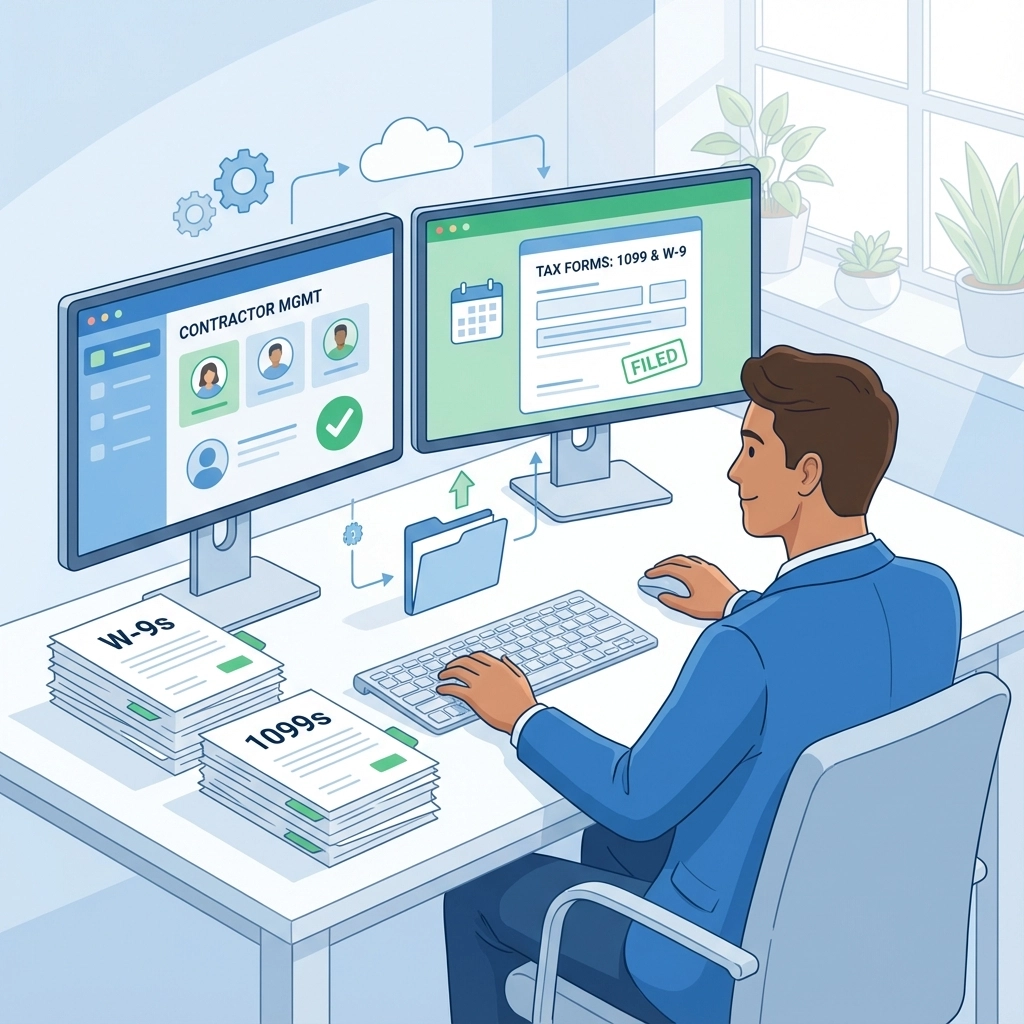
Should I handle 1099-NECs myself or hire a professional?
While you can certainly handle 1099-NECs yourself, many small business owners find it helpful to work with a CPA or bookkeeper. They can ensure you're collecting the right information, tracking payments correctly, and filing forms on time.
If you're feeling overwhelmed by contractor tax requirements, or if you just want to make sure you're handling everything correctly, it might be worth getting professional help. The peace of mind often outweighs the cost.
Ready to Get Your Contractor Tax Requirements Sorted?
Managing contractor payments and 1099-NEC requirements doesn't have to be complicated. At Books on the Go CPA Firm, we help small businesses stay compliant with tax requirements while keeping their bookkeeping simple and organized.
Whether you need help setting up systems to track contractor payments, determining which contractors need 1099-NECs, or handling the actual filing process, we're here to help. Our team understands the ins and outs of contractor tax requirements and can provide the guidance you need.
Schedule a 30-minute consultation to discuss your specific situation and learn how we can help streamline your contractor tax processes. Book your consultation here and let's get your business on the right track.
Remember, staying on top of these requirements from the start is much easier than scrambling to fix things later. Don't let contractor tax compliance become a source of stress for your business – we're here to help make it simple.
