

Do You Really Need In-House Bookkeeping? Here's the Truth
Here's the straight answer: most small and medium businesses don't actually need full-time, in-house bookkeeping. I know that might sound surprising, especially if you've been told that keeping your books in-house gives you more control. But when you look at the real numbers and hidden costs, the math tells a very different story.
Let's dive into the facts so you can make the best decision for your business.
The Real Cost of In-House Bookkeeping (It's More Than You Think)
When most business owners think about hiring a bookkeeper, they focus on the salary. "I can hire someone for $40,000 a year," they think. But that's where the miscalculation begins.
Here's what you're actually looking at for in-house bookkeeping:
Base Salary: $35,000 – $75,000 annually for a competent bookkeeper
Plus the hidden costs:
- Payroll taxes, benefits, health insurance: 25-30% on top of salary
- Recruitment and onboarding costs
- Office space and equipment
- Software licenses (QuickBooks, Excel, etc.)
- Training and continuing education
- Vacation and sick time coverage
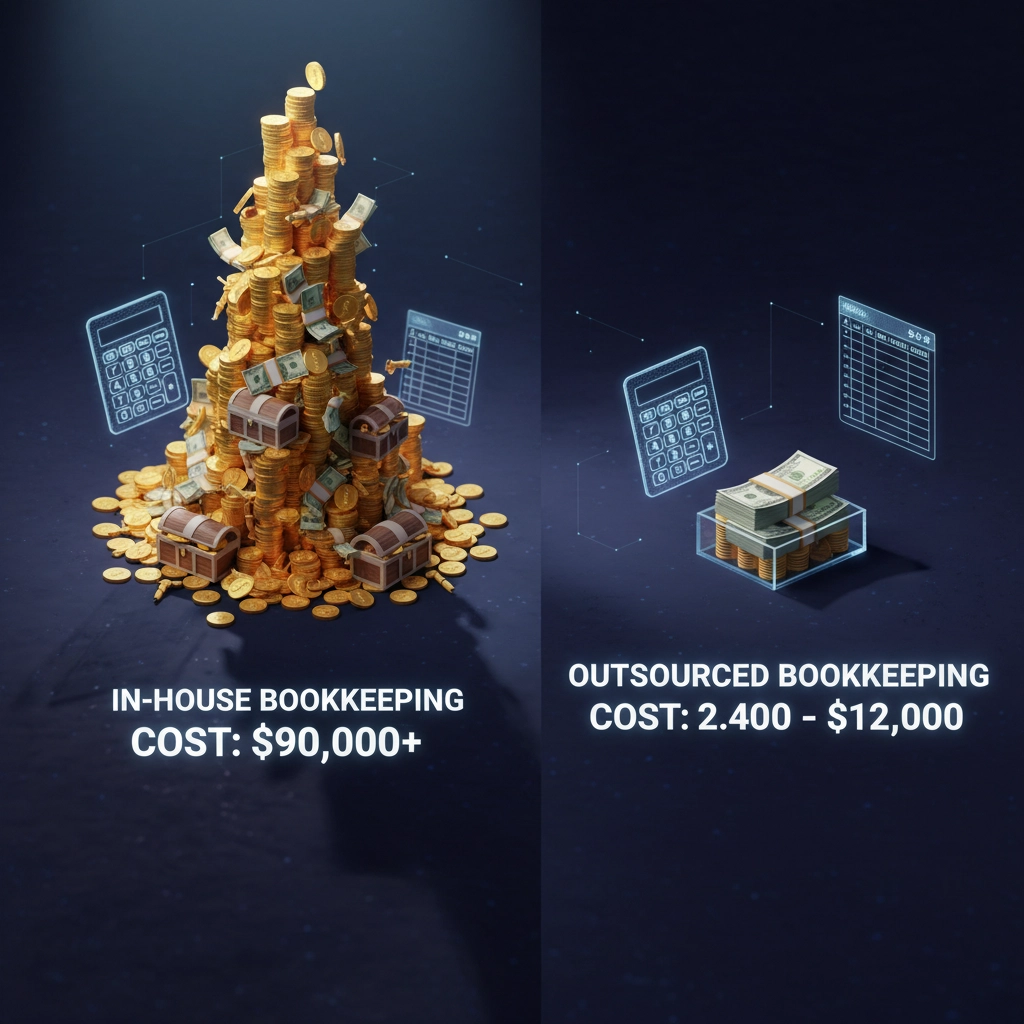
When you add it all up, that $50,000 bookkeeper actually costs you around $90,000+ per year. And that's assuming everything goes smoothly.
Compare that to outsourced bookkeeping services that typically run $200-$1,000 per month ($2,400-$12,000 annually) for most small businesses. The cost difference is pretty dramatic.
The Hidden Problems with In-House Bookkeeping
Cost isn't the only issue. There are several operational headaches that come with keeping bookkeeping in-house:
Single Point of Failure
When your bookkeeper gets sick, takes vacation, or (worse) quits unexpectedly, your financial operations come to a grinding halt. Bookkeeping has high turnover rates, and every time someone leaves, you're back to square one with recruitment, onboarding, and training.
Lost Productivity
Every hour you or your employees spend on bookkeeping is time not spent on what actually grows your business. If you're the owner doing the books yourself, you're essentially paying yourself $100+ per hour to do $20/hour work. That's not smart business.
Accuracy Risks
Unless your in-house person is a trained accountant, mistakes happen. And bookkeeping errors compound over time. Misreported income, missed deductions, or compliance issues can cost you way more than you'd ever save by keeping things internal.
Limited Financial Insights
Most in-house bookkeepers focus on data entry and basic reconciliation. They're not trained to provide the kind of financial analysis that helps you make better business decisions. You end up with clean books but limited strategic insights.

When Outsourcing Actually Makes Perfect Sense
Here's something interesting: if your business generates over $1 million in revenue and you're still handling bookkeeping in-house, you're almost certainly leaving money on the table.
But even smaller businesses benefit from outsourcing because you get:
Professional Expertise: Access to trained professionals who understand GAAP, tax regulations, and industry best practices
Better Technology: Professional firms use enterprise-level accounting software and systems you probably can't justify buying on your own
Real-Time Reporting: Monthly financial statements, cash flow analysis, and key performance indicators delivered consistently
Scalability: Services that grow with your business without the headache of hiring and training new people
Compliance Support: Staying current with changing tax laws and regulations (which is basically a full-time job in itself)
The Strategic Advantage of Outsourcing
Here's what really sold me on outsourced bookkeeping: it converts a fixed cost into a variable cost. With an in-house employee, you're paying the same amount whether business is booming or slow. With outsourced services, you can scale up or down based on your actual needs.
Plus, professional bookkeeping firms have backup systems in place. If your primary bookkeeper is unavailable, there's someone else who can step in immediately. No disruption to your business.

When You Might Actually Need In-House Bookkeeping
I'll be honest – there are a few situations where keeping bookkeeping in-house makes sense:
Highly Sensitive Data: If you're handling extremely confidential financial information that absolutely cannot leave your premises
Complex Integration Needs: If your bookkeeping is deeply integrated with other internal systems and processes
Very Large Operations: Once you hit a certain size (usually $50+ million in revenue), you might justify a full accounting department
Industry-Specific Requirements: Some highly regulated industries have unique compliance needs that require dedicated internal resources
But honestly, these situations are pretty rare for most businesses.
The Hybrid Approach (Best of Both Worlds)
Some businesses find success with a hybrid model: outsource the routine bookkeeping work (data entry, reconciliations, basic reporting) while keeping strategic financial analysis and planning in-house.
This gives you the cost savings and reliability of outsourced services while maintaining control over high-level financial decisions. It's especially effective for businesses in that $5-20 million revenue range.
Making the Switch: What to Expect
If you're currently doing bookkeeping in-house and thinking about outsourcing, here's what the transition typically looks like:
Month 1: Initial setup and data migration (this is usually the most time-intensive part)
Month 2-3: Working out the kinks and establishing processes
Month 4+: Smooth operations with better reporting than you probably had before
Most business owners are surprised by how quickly they start seeing better financial insights once professional bookkeepers take over.

The Bottom Line: Run the Numbers for Your Business
Here's my recommendation: take an honest look at what you're currently spending on bookkeeping – including your time if you're doing it yourself. Then compare that to quotes from 2-3 reputable outsourced bookkeeping firms.
In most cases, the numbers speak for themselves. You'll save money, reduce headaches, and get better financial information to run your business.
The question isn't whether you can afford to outsource your bookkeeping. It's whether you can afford not to.
If you want to explore what outsourced bookkeeping might look like for your specific business, we'd be happy to chat about your situation and run some numbers together. Every business is different, but the math usually points in the same direction.
The truth is, keeping bookkeeping in-house made sense 20 years ago when outsourced options were limited and technology was clunky. Today, with cloud-based accounting systems and professional firms that specialize in small business needs, the old rules don't apply anymore.
Your bookkeeping should support your business growth, not drain resources from it. For most businesses, that means going with the professionals and focusing your energy on what you do best.
